Making a Career in the 1980's
Making a Career in the 1980's
Taking Advantage of Changing Times
The 1980s offered the American Chamber Trio unprecedented opportunities.
The first of these were the unlimited mileage tickets offered by Delta, Eastern, United, and U.S. Air. This meant that we could be in the air 24/7 for three weeks at a rate of $500/ticket. More than that, it enabled us to tour west of the Rockies for the first time. We were able to play in many cities such as Los Angeles, Sacramento, Denver, Phoenix, Pittsburgh, and Atlanta (to name just a few). This would have been impossible if we had to pay for each flight individually.
Besides the fact that we were able to play concerts in these cities, we always had to change planes in Atlanta which gave us the opportunity to listen to last night’s concert and find all the un-vibrated notes, which then became vibrated the next concert. One concert I will never forget was in Los Angeles; The night before we were playing in Beaumont, Texas, and had to make a run for it to wherever it was that we were going to catch our plan to Los Angeles. To our surprise and chagrin, the concert in Los Angeles started at 9 instead of 8, and with a 3-hour time change, our biological clocks were at midnight by the time we started to play. It was a long program which included the Ives’ Trio and Beethoven’s Archduke Trio. In the third movement of the Archduke, I started to fall asleep; I remember fighting for consciousness.
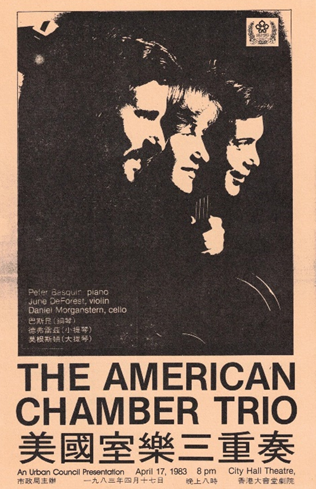
Another big advance for the American Chamber Trio was our first tour to the far east, which June was able to arrange thanks to a fax machine which signed contracts. On that tour we were able to play in Honolulu, Hong Kong, and Singapore. Peter Basquin was so excited to be in Singapore and be able to go to Raffles Singapore where Earnest Hemingway had drunk Singapore slings, and Peter decided to continue the tradition. In Hong Kong, everybody was talking about the problem of 97; That was when the British were going to relinquish their occupancy of Hong Kong.
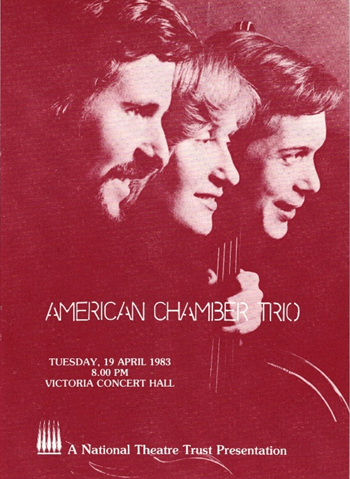
When Eric was appointed to the piano faculty of the North Carolina School of the Arts, he arranged a long tour for us. We played in Raleigh, Charlotte, Durhan, Asheville, and Winston-Salem. We then went to New York to play one concert at SUNI PURCHASE and then toured the Midwest with concerts in Grand Rapids, Milwaukee, Chicago, and Stephen’s Point, Wisconsin. The program that we played comprised of Beethoven’s D Major Sonata, Tchaikovsky’s Rococo Variations, and Brahms’ F Major Sonata. Eric always said once he heard the first notes of the Beethoven D Major, the concert was over, already played in his mind.
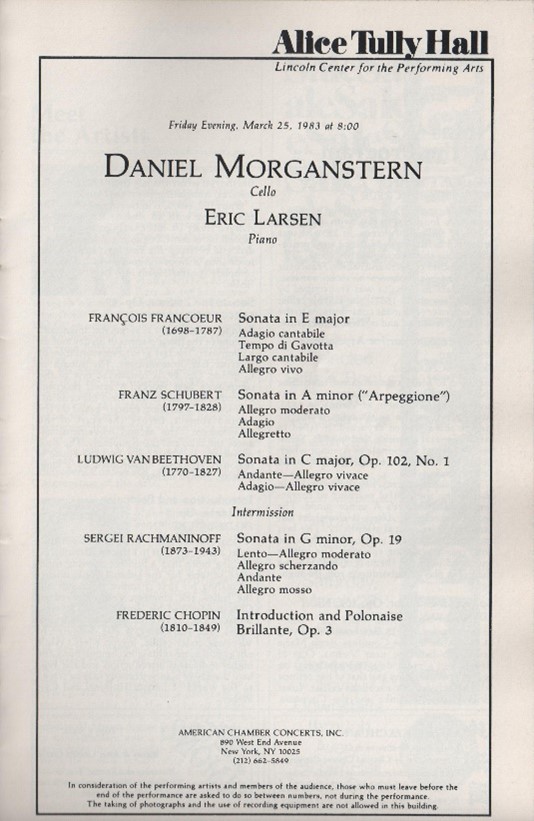
In the next year, which was 1982, we did a similar program we were going to play in Alice Tully Hall in 1983. That program consisted of Schubert’s Arpeggione Sonata, Beethoven’s C Major Sonata, and the Rachmaninoff Sonata.
June did a New York recital in 1981 of the music of Bartok to commemorate the 100th anniversary of his birth. In her program, she played Bartok’s First Sonata with pianist Bernard Rose and the Contrasts with clarinetist Larry Guy, which she played in the big hall at Cooper Union in New York.
In 1983, Eric and I played a recital at Alice Tully Hall, after which the trio made its first international tour to Hong Kong and Singapore.
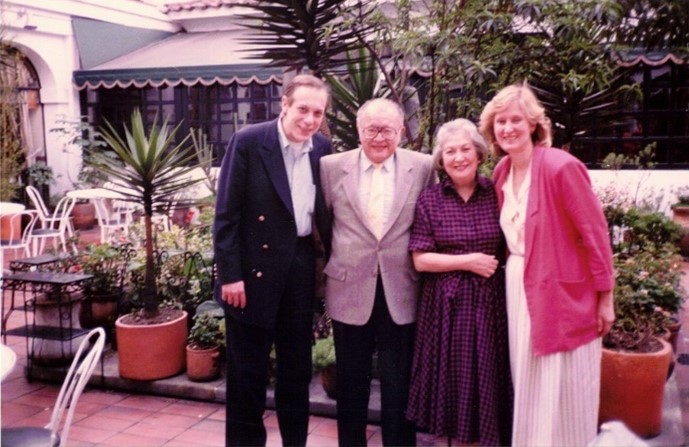
June was able to arrange a South American tour for us with the help of Jaime León, who was a very important musician in Bogotá, Columbia. He was also the music director of the American Ballet Theater from 1968-1972 and was able to get a major manager to present us in Bogotá.
One of the big problems with playing in Bogotá was that the stage was raked at a 30-degree angle. That made my up bows go down, and with June it was the opposite. I would like to say that we were triumphant in Bogotá, but I daresay we did not play well and were crucified by the music critic. The day after we played, the American Embassy was bombed, so the climate was not good for the AMERICAN Chamber Trio. Nonetheless, Jamie supported us and told us not to worry about critics, particularly in Bogotá.
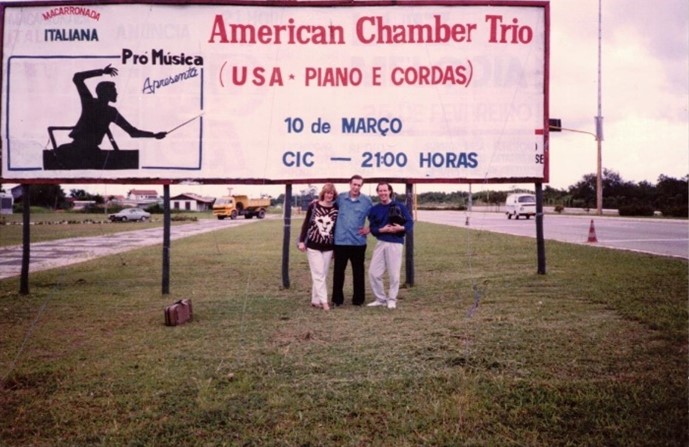
June contacted a Brazilian manager named Barbara Starr Wolff with whom June made a deal that we would play as many concerts as she wanted to book us for at $200/concert.
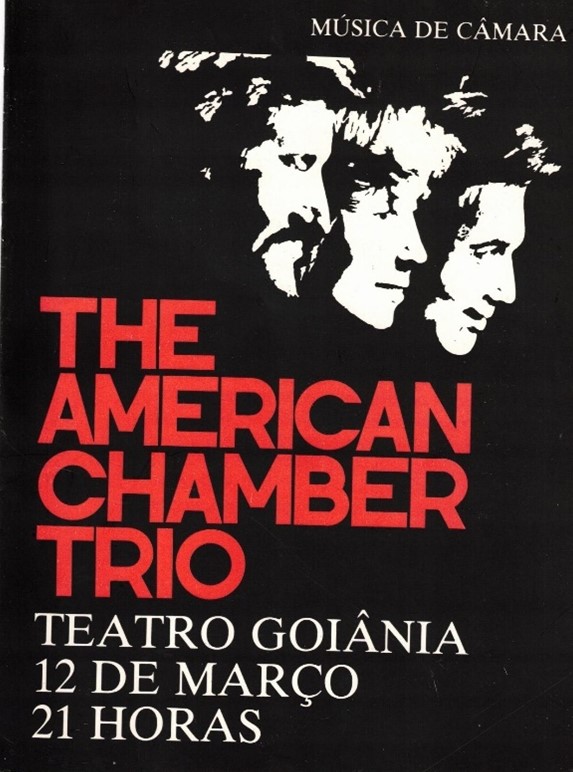
WELL, Verig Airlines also had an unlimited mileage ticket, and Barbara S.W. had us playing every night for ten nights. However, in South America, the concerts start at 9, not at 8, and the South Americans love their parties, which we were obligated to attend. It was required of us to be at the airport at 6 o’clock so that we could arrive at the next city to be on the 8 o’clock news. Usually, our bedtime on that tour was 9 or 9:30 am. In her favor, Barbara had one of her employees, Betty Stegman, accompany us and made sure that we didn’t get into any trouble, and Barbara did get us some big dates in São Paolo, Brasília, and Rio.
Another great coup for June was making friends with John Lane. John Lane was the entertainment director for the Epirotiki Cruise Lines. Among other people that he engaged were William Bolcom and his wife Joan Morris. They were quite famous for American popular songs and recorded 25 albums together.
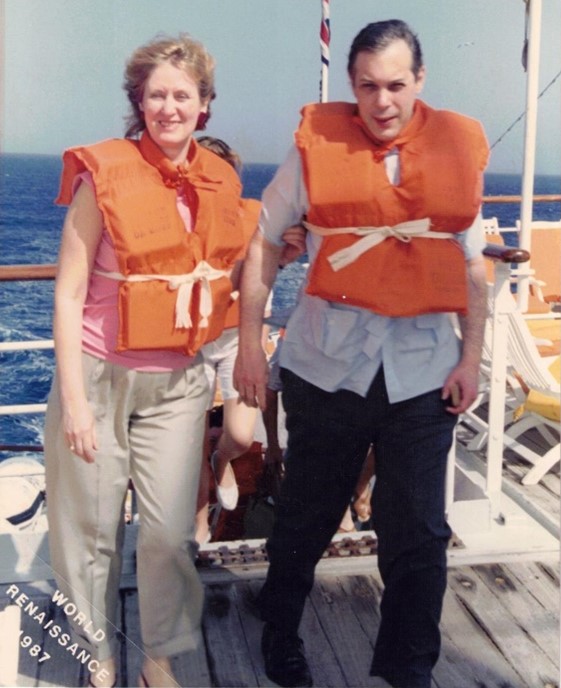
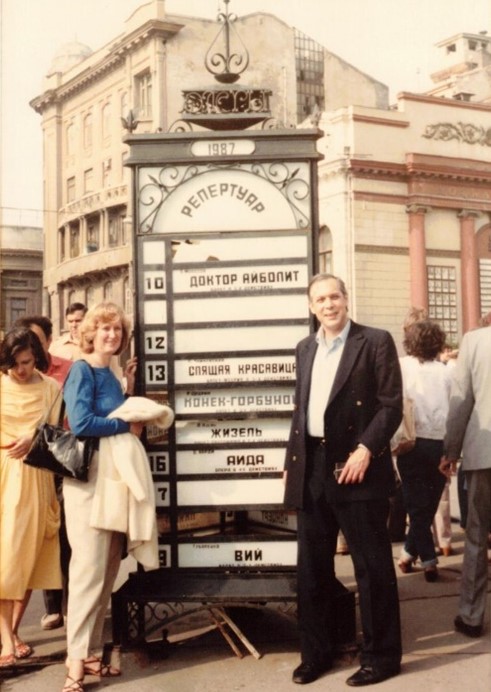
Our first cruise was to Alaska from Los Angeles and back. Another big one that we did was from Buenos Aires to Rio de Janeiro. A third, which was the largest one, was two weeks through the Mediterranean and Black Seas, which started in Nice and ended in Odessa. Our only obligation was to play one 45-minute concert a week. At a certain point, John Lane jumped ship and signed on with American Cruise Lines. Unfortunately for all of us, American Cruise Lines never got out of Greece, and we never heard from John Lane again.
In the 1980s, besides doing the usual three-week tours, we did present five concerts of real consequence.
In 1981, June presented a New York recital in 1981 of the music of Bartok to commemorate the 100th anniversary of his birth. In her program, she played Bartok’s First Sonata with pianist Bernard Rose and the Contrasts with clarinetist Larry Guy, which she played in the big hall at Cooper Union in New York.
In 1983 Eric and I played a major recital at Alice Tully Hall.
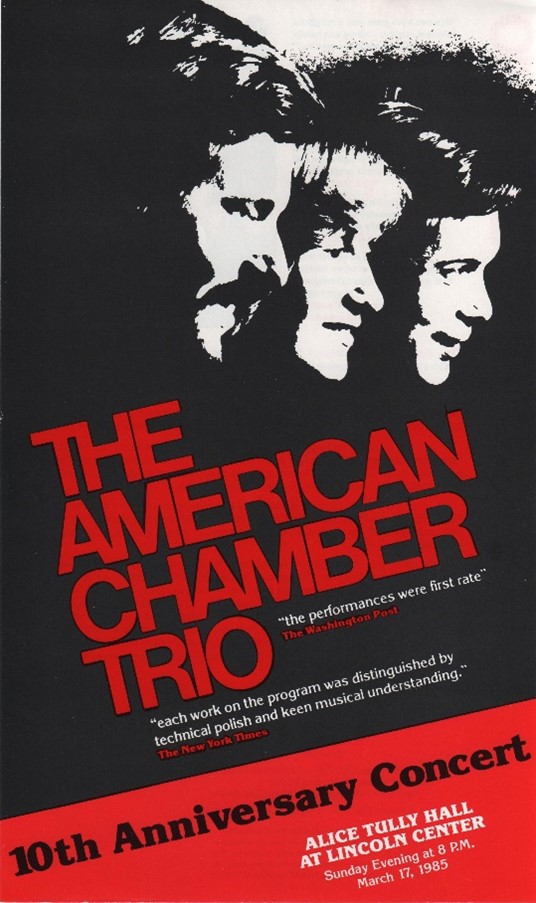
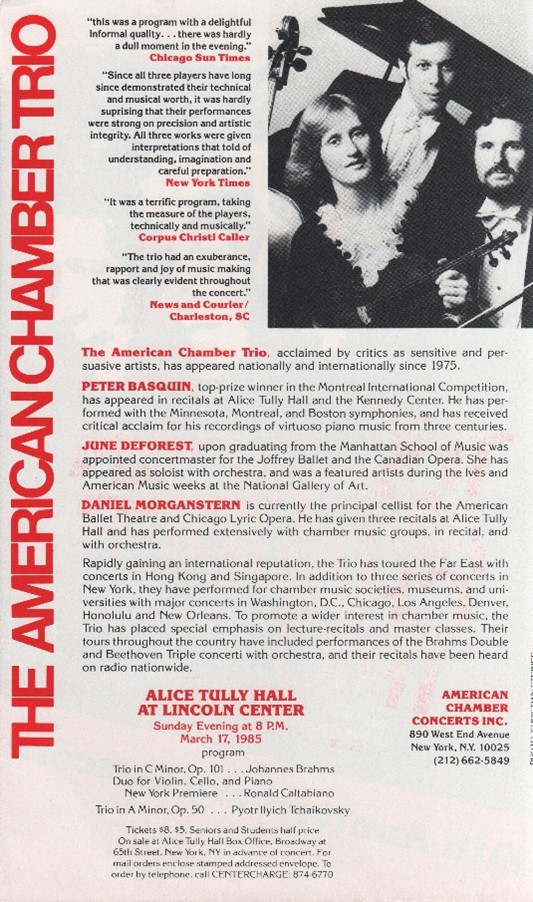
In 1985, the Trio presented our tenth anniversary concert. We commissioned a trio to commemorate the occasion by a composer named Ronald Caltabiano and gave its world premiere at the National Gallery. We did, obviously, the New York premiere as well. Sometimes in life, you make mistakes, and this was a big one. The score reminded me of the score to Lulu by Alban Berg, except that the tempos were faster. It involved syncopated eighth notes in 3/2 time, and the only way we could get if right (or even close) was when I made half speed recordings of both the violin and cello parts and then played along with the resulting tape at full tempo so we could at least get it by ear. When I listen to the recording of the concert, it might have been written aleatorily for all the sense that it made. This experience created a permanent allergy to all contemporary music that involved serious counting and the possibility of hemorrhaging the grey matter in my brain. Heifetz was famous for saying, “I occasionally play contemporary music for two reasons. The first is to convince the composers to write no more of it, and the second is to remind myself how much I appreciate Beethoven.”
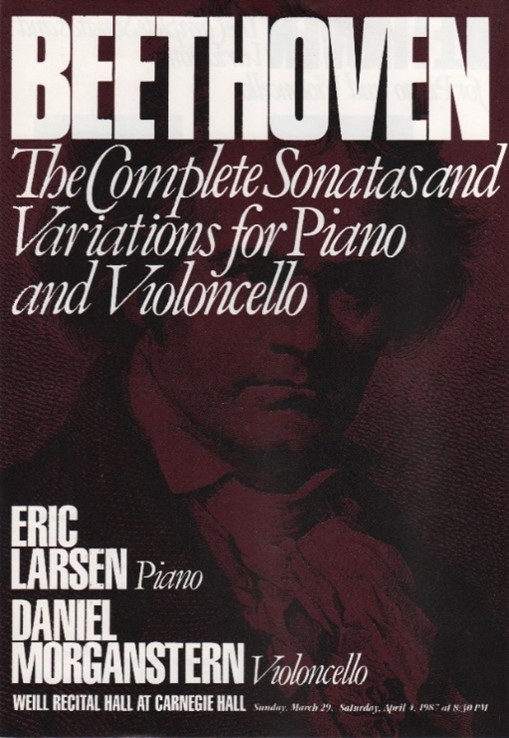
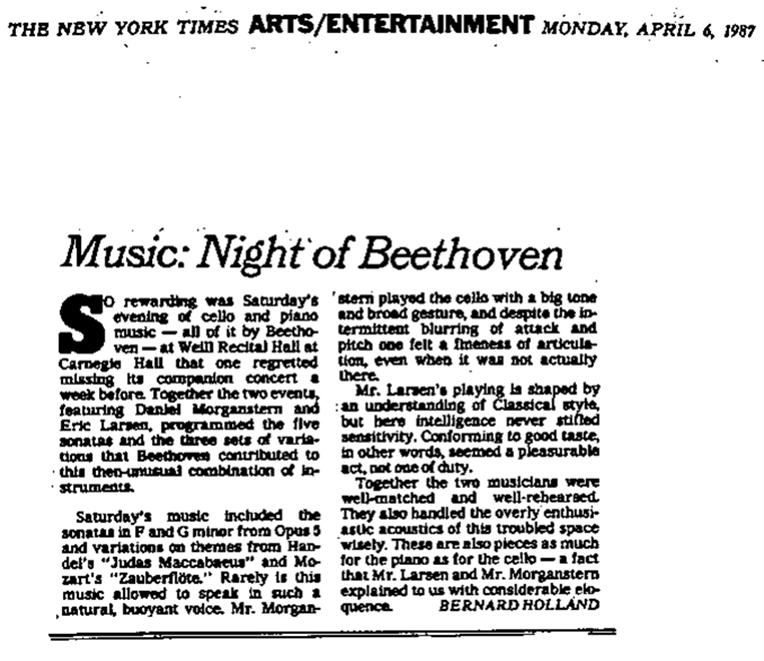
The fourth of our major events was my Beethoven cycle with Eric. That event panned out much better for us in as much as we recorded all these pieces to our satisfaction and got a wonderful review in The New York Times.
The final event of the 1980s was June’s recital of the music of Ravel. She played the two violin sonatas and the trio with me and Eric and, eventually, recorded all these pieces.
Copyright Daniel Morganstern. All Rights Reserved.