Fundamental Changes About the 90’s
Fundamental Changes About the 90’s
In 1990, June decided that she wanted to teach. Before any sign of her getting a job appeared, she took off both the Lyric Opera season and the American Ballet Theater season and started looking in The College Music Society for openings, and she started preparing for auditions. I kept bothering her, “WHY do you want a $15,000 a year job in the middle of Iowa, or worse, Kansas, when you can make so much more money playing at the opera or at the Met with the ballet?” She actually did go down to Florida and auditioned for one of those $15,000 a year jobs, which she didn’t get, but she was prepared. In her fingers, she had the Mendelssohn concerto, the Bach E Major Partita, and the big violin solo from Strauss’ Ein Heldenleben. She also prepared a tape of performances we gave on WFMT of the Tchaikovsky Trio and the Kodaly Duo. At the last minute, an important job opened up at the College of Wooster in Ohio for a distinguished visiting professor of music. Needless to say, she got it by acclamation, and this became the foundation for a long and successful teaching career.
It was because of her appointment at Wooster that she was approached by Valparaiso University to teach there in conjunction with her position at the Lyric Opera.
One of the things that June took the most seriously was teaching the violin. She had no ambitions to go into competition with Almita Vamos or Dorothy DeLay, so her ambitions were not about the aggrandizement of her reputation, but entirely for the students. It didn’t matter to June whether her various students had talent or brains, but she was willing to go the extra mile to get a very sub-standard talent good enough to pass her exam to get her degree. On the other hand, if she did have somebody with talent and could bring them up to a respectable level, she would enter them into the Music Teachers National Association Competition, pay the entrance fee, drive them to the competition, and pay for the pianist. Five of them represented the state of Indiana, which definitely upgraded their resumes, either going to college or to graduate school. She went out of her way to make friends with important violin teachers in big universities so she could place her students, and they were happy to have her sending students to them who were well-trained and knew what was required.
Since June felt that David Nadien had taught her how to think on the violin, she oriented all her teaching to a think-on-the-violin model. Early on, she noticed that the students that came to her were stuck in first position, so she put them into third position, uncomfortable as it must have been, right away. She always had two stands in her studio so that she could see what her students were playing and how and demonstrate how to make it better.
The next truly fundamental change in our lives in the early 1990s was June’s determination to take care of her 85-year-old mother, which required us to move from New York to Chicago. Since real estate prices were way below those in New York, we were able to exchange our New York apartment, which had two bedrooms on West End Avenue, for a twice as large three-bedroom apartment on Lake Shore Drive. Where we had always been transients in Chicago, being a transient in New York (Presidential Towers does not exist in New York like it does in Chicago; clean, comfortable, and spacious with an indoor gym and swimming pool) to do the American Ballet Theatre seasons became unpleasant and expensive. This led to our resignation from the American Ballet Theatre in 1998. I’m gratified to be able to say that I played my last big solos at the Metropolitan Opera House at the top of my game.
Just like in 1980, when unlimited mileage tickets made it possible to play concerts west of the Rockies, in 1990 Amazon.com made it possible to have a recording career. Amazon offered advertising and distribution, which made it possible to be taken seriously by publications such as The American Record Guide.
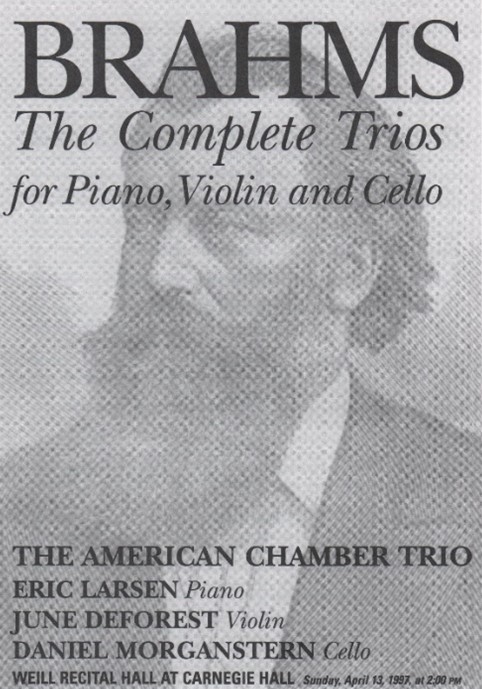
At the same time, our very good friend Hensom Markham went into business with his brother producing CDs. The CDs that he produced were mostly Country and Western, but the digital world did not discriminate and, in a very short time, we were able to record a great deal of our repertoire on CDs. Additionally, Hensom was a very fine graphic artist and created the covers for all of them. We started in 1996 with the three last Beethoven Cello Sonatas. In 1997, we played three Brahms Trios in Carnegie Recital Hall and recorded the C Major and the C minor Trios, which later got added on to the complete Brahms Trios plus Beethoven’s Archduke Trio. In 1999, we recorded the Ravel and Tchaikovsky Trios.
All these recordings were made in Duesenberg Recital Hall at Valparaiso University. ALSO, Valparaiso University had a 9-foot Steinway Grand in very bad condition. June and I made a deal with Valparaiso that if we re-conditioned their piano, we could record in their hall as much as we wanted.
Additionally, Eric and I released our recording of Chopin, Schubert, and Rachmaninoff in 1999.
At the end of 1999, we released live performances of Beethoven’s Op. 5 Sonatas and the Kodaly and Ravel Duos.
Inspiring Times at the Opera and Ballet
Two conductors that impressed me as being genuine geniuses were Daniel Gatti and Christian Thielemann. Daniel Gatti came with Madame Butterfly and then did Masked Ball, Simon Boccanegra, and Don Carlo. There was no doubt in my mind from the very start that Gatti was a genius who was able to create magical sounds and great fluency in the orchestra. In previous writings, I spoke about how he influenced my interpretations of the big cello solos in Masked Ball and Don Carlo.
It was a great privilege, pleasure, and educational opportunity to do two of the greatest Verdi operas (in my opinion), Simon Boccanegra and Don Carlo. To me, these two operas represented the absolute greatest evolutions of Verdi’s phenomenal creative talent.
Doing them with Gatti infused the very essence in both operas into the marrow of my bones, and I will always be grateful to him for revealing the great moments in full flower.
Christian Thielemann exerted so much force over the orchestra that it was almost as though his will was made manifest simply because of the strength of its intention. I’m pleased to say that Thielemann recognized me and, when my father died, he called me and asked when I would come back to help him. When Thielemann conducted the Chicago Symphony, many people said the Chicago Symphony never, ever sounded like what he brought out of them.
Without any shred of doubt, the pinnacle of my experience at the Lyric Opera was Zubin Mehta’s Ring Cycle. It was outstanding in several ways. First was his conception of the opera based on letting the leitmotifs tell the story and characterizing them with tremendous vitality. Second, he was such a good conductor that it was impossible not to be with him. The Ring consists of four operas, three of which are between five and six hours long. Mehta’s advice was to think of it as one big opera and let yourself be guided by the leitmotifs, which remain consistent throughout all four.
In my time at the Lyric Opera, I did three Ring cycles. The first was with Ferdinand Leitner. His interpretations were always spot on as far as what the music demanded. However, at that time, the Lyric Opera Orchestra was not what it became, and Leitner’s great conception realized less than 100% of what the performances could have been.
With Zubin Mehta, the orchestra was much, much better, and everybody had a mixture of fear and respect for the former Music Director of the New York Philharmonic. Nobody did not take Zubin Mehta 100% seriously, and he brought a great conception and fantastic conducting to the enterprise. Many times, he was in the opera house around the clock and rehearsed us totally meticulously and brought out the best in everybody, certainly including me.
At the end of the third cycle, as we were walking up to the stage to take our final bow, I was standing with him and told him, “I cried when it was over,” and he turned to me and said, “So did I.”
Two stories that remain embedded in my memory:
1. There is a very difficult passage in Das Rheingold. I asked him, “How did other cellists deal with it?” He said, “If you don’t know, who does?” I explained that it went too fast to play, and he said, “No problem; I can slow it down and pick it up after.”
2. On the opening night of Die Valkyrie, there was a significant cello solo which I played exceedingly well. At the end of the act, Mehta came off the podium and took my hand warmly and said, “That was a beautiful solo.” For me that was the greatest compliment I got because Zubin Mehta played with every other principal cellist in the world.
The third Ring cycle was with Andrew Davis in 2005. I make no comment on its inspiration and understanding.
Another perk of working at the Lyric Opera during the 1990s was the opportunity to work one-on-one at times, with interesting composers. Two stick in my mind, the first being Marvin David Levy who composed Morning Becomes Elektra. I was at the premiere of the opera at the Met because my dear friend Marie Collier was singing the lead role of Christine. Levy and I had lots to talk about, such as what it was like working with her. As we worked through the opera, certain things in the cello part suggested to me that they could be better done. Levy not only took my suggestions but marked them in the score with my name attached.
The other interesting composer was William Bolcom who was commissioned to compose four operas. The first one, McTeague, was very good and, due to my habit of staying in the pit during intermissions, I had plenty of opportunities to talk to Bolcom as well and Levy about their operas since they were always sitting in the front row waiting for the rehearsals to begin again.
While there was nothing as earth-shaking as the events at the Lyric Opera, the 1990s created a great deal of pride and pleasure at the ballet. Two of my colleagues, Jon Manasse and Matthew Dine, were totally world class players, and having the opportunity to interact with them on a constant basis gave me some of the greatest pleasure of my career. Among many things, Jon Manasse became principal clarinet of the Metropolitan Opera before he went on to pursue a solo career, which yielded many fantastic recordings.
On my very last solo of the American Ballet Theatre Orchestra, I was determined to do my best, and so I locked eyes with Matt Dine and there was a palpable electricity between us, and I played the best solo of my career to end my tenure with ABT.
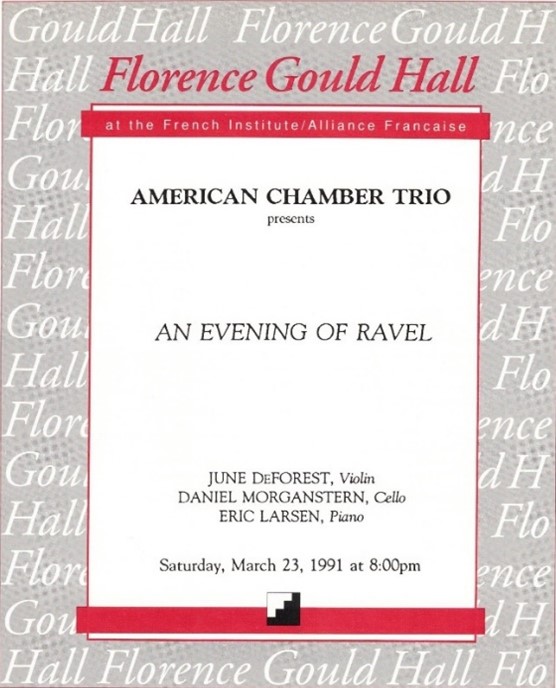
With large changes in our lifestyle, we had to cut out a great deal of touring, but we did do two significant concerts in New York. The first was the Ravel concert, which was comprised of the violin piano sonata, the violin cello sonata, and the trio, which was performed at Florence Gould Hall. The second was comprised of the three Brahms trios, which was performed Carnegie Recital Hall.
Copyright Daniel Morganstern. All Rights Reserved.