Making a Career in the 1970's
Making a Career in the 1970's
Origins of a New Life
The genesis of our chamber music career occurred in 1968 at the Metropolitan Opera House during one of the big American Ballet Theater seasons. June’s stand partner was Joyce Robbins, a definite big shot, who took me aside and told me that, if I wanted to have a happy marriage, I should make sure that June also had a career.
Rosand had been engaged to play the big violin solos in Swan Lake, which gave me the opportunity to play one-on-one with him. He liked my playing very much and offered to help me move my career forward. His associate in the CBS orchestra (on the C stand) was Elliot Magaziner. Elliot had a piano trio involved in a summer festival in Reston, Virginia. The cellist in this trio had severe alcohol problems and needed to be replaced. Aaron recommended me in the most glowing terms, and Elliot invited me to play trios with him and his pianist David Poliakin informally in order to check me out. We played the Schubert B Flat Trio and the Mendelssohn D Minor Trio. at David’s house in Great Neck while our wives listened attentively. With that evening the deal was sealed and I became the cellist in the Reston Trio.
Since, up to that point, I had played exactly one serious chamber music concert, it was daunting to face six weeks of concerts each of which had three pieces on the program. Additionally, before and after the six-week summer session we did small tours in the area with June playing second violin in a string quartet program in five or six concerts playing the Mozart Dissonance Quartet, the Dohnányi Serenade, and the Debussy Quartet. All these concerts were associated with the Northern Virginia Music School at Reston. SO, in addition to getting a chamber music concert put together every week we also had other responsibilities. Mine involved playing in the orchestra, coaching the cello section and chamber music groups in the afternoon, and playing the Dvorak Concerto with the orchestra.
For me, it was a formidable challenge to get pieces like the Tchaikovsky Trio, Mendelssohn D Minor, Schubert B Flat, Trout Quintet, Mozart Divertimento, and 13 others up to performance standards. Elliot had a very hard-nosed attitude about showing up and doing your job. He didn’t care that I had never played the Tchaikovsky Trio, only that I showed up on Wednesday evening and played it. In this environment I learned to prioritize what and how well needed to be played and get from beginning to end without stopping. I would like to add these were two things that I did not learn at Juilliard.
Because of Elliot’s enthusiasm for the results of our work he booked Carnegie Recital Hall for two concerts the following March and May. In retrospect I have to admit that I owe Elliot Magaziner a great deal for having me put up on an important New York stage for the first time in my life. I was absolutely petrified at the prospect of being unfairly reviewed in the New York Times for all to see. If it had been up to me, I wouldn’t have done it at all. Thanks to surviving the experience of playing two New York concerts in Carnegie Recital Hall, I had the confidence to make my Alice Tully Hall debut one year later and what would end up being at least 25 other New York concerts. My mother wrote a poem: It’s a little step from one to two, it’s a little step from two to three BUT the step from zero to 1 could take eternity. During the lead up to those concerts I was insecure to the nth degree. Elliot basically shepherded me through to the best possible conclusion, and I will always be grateful to him for his unwavering faith in me, his willingness to back it up with his money, and his willingness to put his own career on the line playing with me in these concerts. The second summer spent at Reston involved my first performances ever of two of the most difficult pieces in the cello repertoire, the Haydn D Major Concerto and the Schubert Arpeggione Sonata. Since I was anticipating making a solo debut in New York at Alice Tully Hall I used my connections in Reston to play the Francoeur Sonata and the Schubert Arpeggione at least ten times in the area. June filled out the program with the Debussy Violin Sonata, and we played the Brahms B Major Trio to conclude the program with our pianist friend Gordon Steel who came down to Reston to help us out. This was an absolutely invaluable experience because it was sort of like a boxer who starts with easy opponents as he works his way up to the heavy weight championship.
It was in conjunction with my Alice Tully Hall debut (a rite of passage that I decided to undertake at that time) that I got my first whiff of the incompetence and unnecessariness of managers. Everybody told me you have to have a manager in order to be credible, so I used connections of mine to get one. Her name was Sarah Tornay. I charged her with booking Alice Tully Hall for me on May 15, 1971. Additionally, she was supposed to print up a flier, do something about getting an audience, and getting the New York Times to review it. I asked her to take care of these things in May of 1970. When I got back to New York after the 1970 Lyric Opera season in late December I called Alice Tully Hall to make sure that I got my date. The manager whose name was Louise Homer (not the famous opera singer of the same name) told me that she never heard of me and May 15th was already taken by the Chamber Music Society of Lincoln Center. I asked her whether May 22nd was available she said it was. I asked her what I needed to provide in order to get it. I said that I could provide reviews and letters from conductors. She said, “Just bring a check.” I have written about this extensively before, but briefly, I went down to Alice Tully Hall and gave Louise Homer a check. Then I went to the front of Alice Tully Hall and checked out fliers for upcoming events. I noticed that the very best fliers came from the management of Sheldon Soffer known to my dear friend Hensen Markham. I called Hensen if he could find me the name and telephone number of the graphic artist that worked for Soffer. He did, and I immediately called this man (Walter Harper, a great graphic designer who worked for me for the next 20 years. Below are examples of his work and the results that they brought me.) and went down to see him right away and told him what I needed.
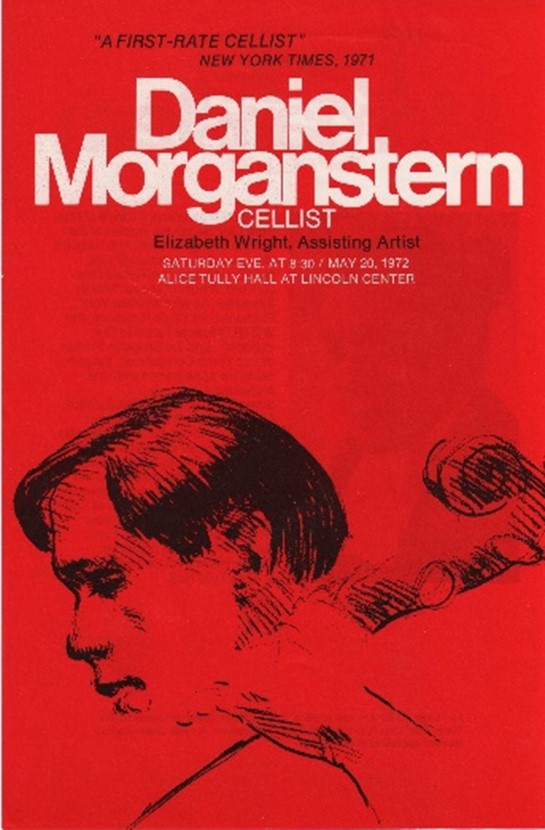
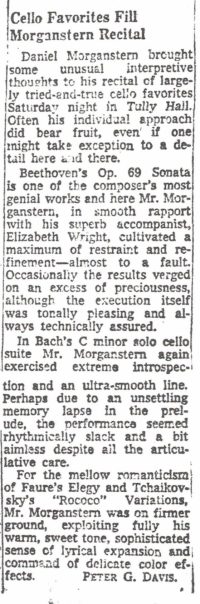
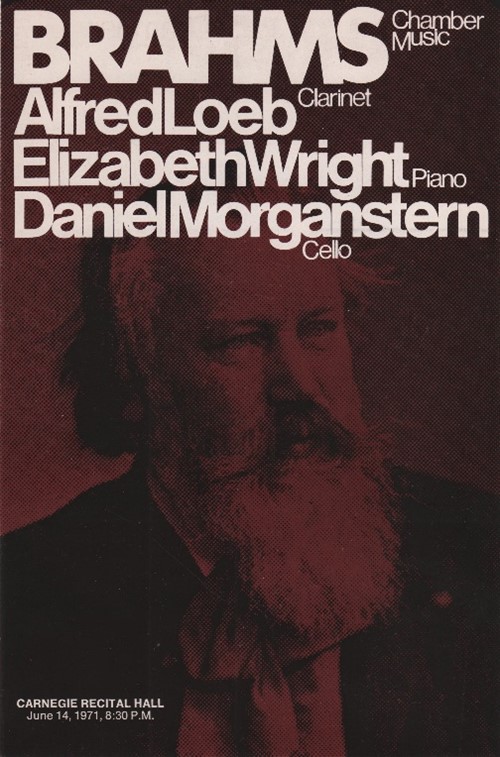
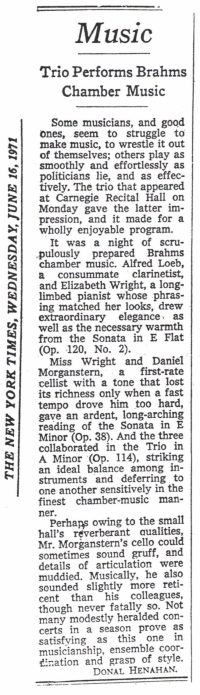
SO without the help of management I had a hall and a flier. In terms of getting an audience I wrote letters to everybody I had ever known, inviting them to come to this concert, and in a word, had the first full house in the history of Alice Tully Hall for a debut recital up to that date. I also got a good review and a fantastically good one two weeks later on another concert (which I also organized) at Carnegie Recital Hall from of all people, Donal Henahan, the terror of the New York Times, who dubbed me a “first-rate cellist” a quote which I have used for nearly fifty years.
As we found from our experience in Reston there was absolutely no substitute for small concerts in an unthreatening environment to prepare for the big ones, and that is how the American Chamber Trio got launched. During my time at Reston I heard advertisements on WGMS Washington, D.C. for the Coolfont Recreation and Conference Center in Berkley Springs, West Virginia who hosted concerts of students from the Northern Virginia Music School. Because ABT had a summer season at the New York State Theatre I had decided not to return to Reston . I wrote to the owners of Coolfont asking whether they would like to have professionals, like me and June, for their summer concerts instead of students. They responded almost immediately asking us to come down for a week and play four concerts, Thursday, Friday, Saturday, and Sunday.
In order to fulfill this engagement, we needed a pianist. June had gone to the Manhattan School of Music with Peter Basquin. We asked him whether he would be interested and he agreed after telling us that he had just won the Montreal International Piano Competition. Even at that high point in his career, it was not lost on Peter that the chance to play next year’s repertoire four times in public was a very good idea. I also had a recital at Alice Tully Hall planned for 1972. And like me, Peter had played a debut recital at Tully Hall in 1971. The three of us went down to Coolfont and played our four concerts and stated a relationship that continued for the next 33 years.
Over time Peter played at Coolfont important works of Rachmaninov, Ravel, Liszt (particularly the 6 etudes of Paganini), and the paraphrase from Rigoletto. I believed it helped him prepare his 1974 Alice Tully Hall concert where he played, if memory serves, works by Brahms Op. 117 or 118, Beethoven’s Apassionata Sonata, and Stravinsky’s Petrouchka brilliantly. Many years later I got the recording of Andre Watts playing the 6 Paganini etudes and if he played them better than Peter he didn’t play them much better.
I prepared and played the Boccherini A major and the Schubert Arpeggione Sonata all four of those first concerts. In later years I played multiple performances of sonatas by Brahms, Beethoven, and Rachmaninov, all of which I recorded. Also, June and I did multiple performances of duos by Kodaly and Ravel which we also recorded.
We played on and off together for the next three years and decided to play serious concerts in New York in 1974. We booked the New York Cultural Center for three concerts, one of which was devoted to the music of Charles Ives. Because of this concert, we were invited to play at the National Gallery of Art in Washington, D.C. on their series devoted to the 100th Anniversary of Ives’ birth. Also, we were invited to play at the Museum of Contemporary Art in Chicago.
We recognized at that time that while there were many artists, there were relatively few managers. After two other encounters with managers of different sorts we decided to incorporate since we knew that every presenter always knew a better artist or a cheaper artist. To put ourselves on a level playing field to deal with presenters on an equal basis, we decided to become a management ourselves and incorporated as American Chamber Concerts, Inc. In 1975 the American Chamber Trio made its debut at Carnegie Recital Hall in two concerts with large audiences and good reviews.
During the time that led to this decision, I had two encounters with functionaries of organizations that supported young artists. The first was the New York State Council of the Arts. At that time everybody wanted to be able to say, “This concert was made possible by the New York State Council of the Arts.” I went down to talk to them in my best suit and shined shoes to tell them that I wanted to play concerts. They told me all their grants were matching grants, so I offered to give them a check for $2,500. They rejected that idea saying, “That I had to actually raise the money from many different donors,” and then write a proposal for something which they would either approve or not. I explained, very patiently, that my fundraising ability was worth five dollars an hour tops but my cello playing ability was worth at least $25 to $35 dollars an hour, and besides which, why would I want to write a proposal for something that would interest them which they could also reject to play for a rate of pay I wouldn’t consider in the commercial world. So, with that insight, I decided that I could damn well finance my own concerts, and play the things that I wanted to play, when I wanted to play them, and if I was lucky, and persistent, and practiced hard enough how I wanted to play them.
The other insight that manifested in those years leading up to our incorporation as American Chamber Concerts, Inc. was when I auditioned for an organization called Affiliate Artists. Their grant was $10,000 to do ten weeks of concerts someplace in the Hinterlands, if you got it. Anxious to get one of these grants for myself I practiced assiduously for six weeks on my very best repertoire, all of which I had played at Alice Tully Hall. Even if I have to say it, I played really, really well at my audition. Right after I played, a colleague of mine played in a totally substandard manner. When he got it and I didn’t I recognized the fact that going hat in hand to anybody was a total waste of time and much better to create my own opportunities where any competition would have to come to me.
In order to establish ourselves as legitimately important chamber musicians, we arranged three series of concerts, starting with our New York debut in Carnegie Recital Hall. Our ambition was to play most of the standard repertoire in New York.
In 1975 we presented two concerts. At the first concert, we played Beethoven’s Opus 11, Brahms’ Trio No. One, and Ives’ Trio. In the second, we performed the Schubert B-Flat Trio, the Ravel Trio, and Amram’s Dirge and Variations.
In 1976, we presented three concerts. For the first, we played the Haydn C Major Trio, Ravel Trio, and Schumann D minor. The second concert was a cello recital, where I played the Francoeur Sonata, Beethoven D Major, and Rachmaninoff. The third concert was comprised of the Kodaly Duo, Myron Fink’s Trio, and the Brahms’ G minor Piano Quartet with Rami Solomonow playing the viola. The flyer for these concerts, as always, was designed by Walter Harper.
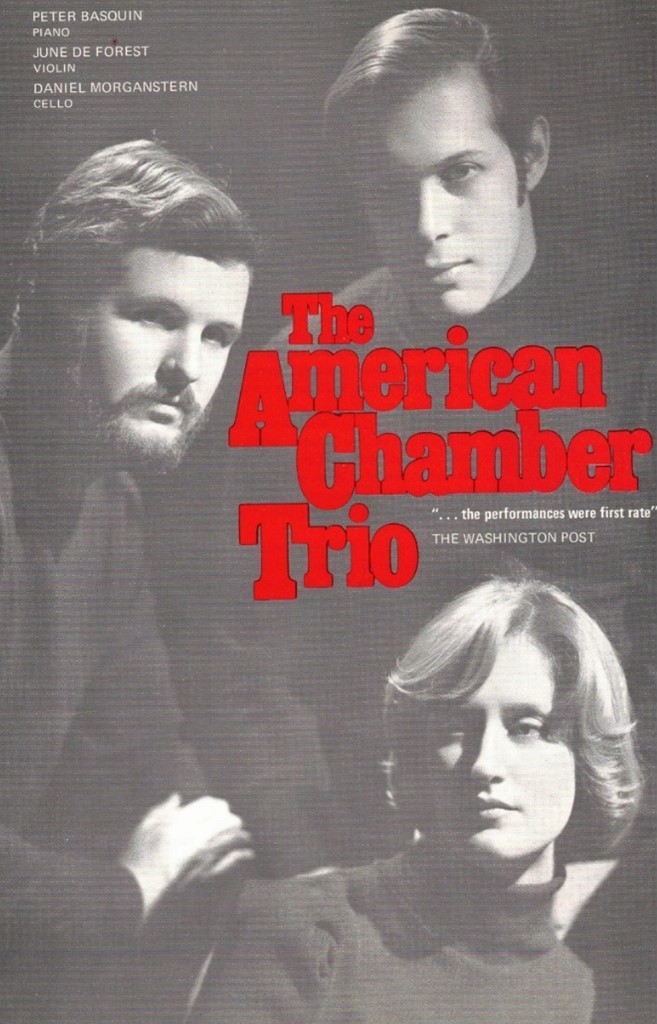
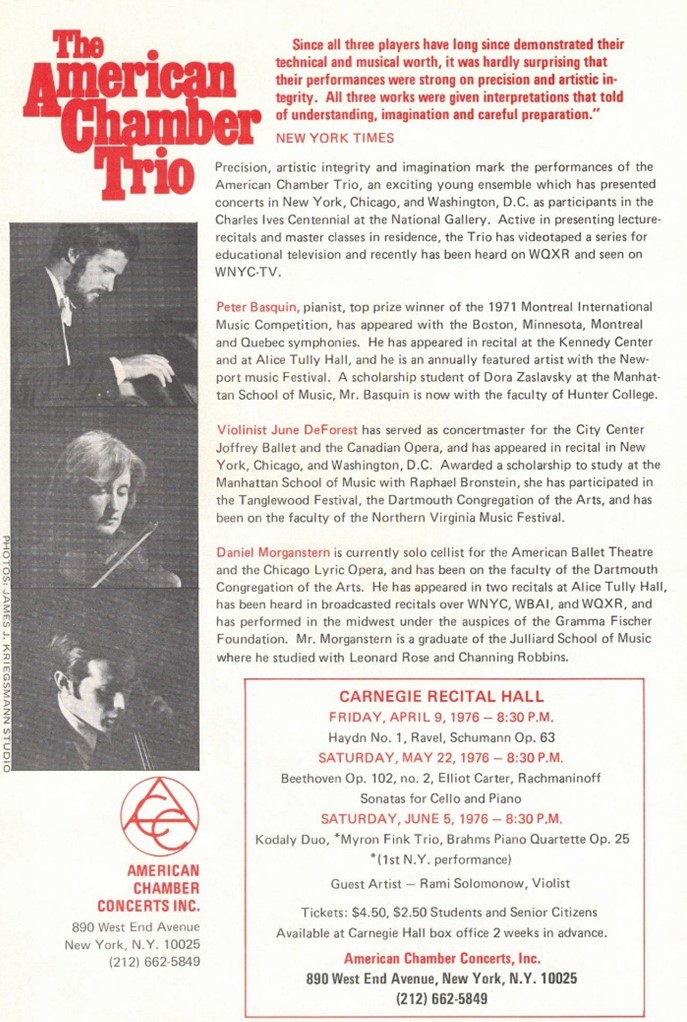
In 1977, we presented four of the major piano trios in two concerts. For the first concert, we played the Beethoven Archduke Trio and Mendelssohn’s D minor Trio. For reasons I will go into later, we avoided contemporary music like the plague. One of our departures from this disdain for contemporary music was when we played the New York premiere of Rebecca Clarke’s Piano Trio. This trio, and her viola sonata, became staples of the repertoire, and I was very pleased to be able to play for her and know her, as was June. This trio was played at the second concert, as was the Brahms’ C minor Trio and the Schubert B-Flat Trio.
Picture Text:
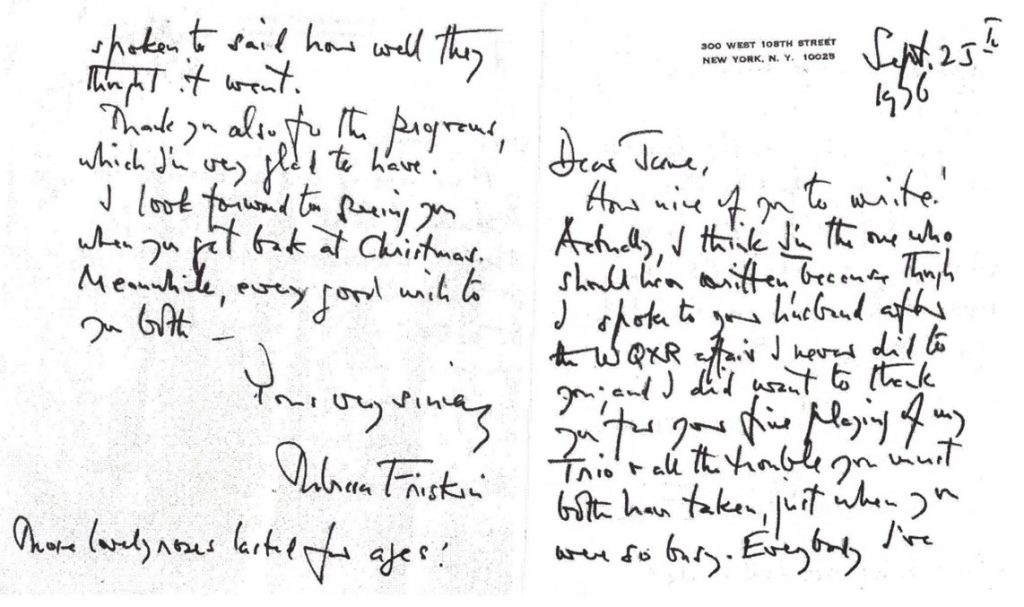
Dear June,
How nice of you to write! Actually, I think I’m the one who should have written sooner though I spoke to your husband after the WQXR affair, I never did to you, and I did want to thank you for the fine playing of my trio and all the trouble you both have taken just when you were so busy. Everybody I have spoken to said how well they thought it went.
Thank you also for the program, which I’m very glad to have. I look forward to seeing you when you get back at Christmas. Meanwhile, every good wish to you both.
Yours very sincerely,
Rebecca (Clarke) Frisken
In our quest to establish ourselves as significant players, we were greatly aided and abetted by changing times and technologies.
At the time of our initial Carnegie Hall series, the cost of renting the hall started out as $150 for an evening and stayed relatively close to that level throughout the 1970s. There was, therefore, no financial constriction on playing as many concerts as we wanted to at Carnegie Recital Hall.
Also, at that time, The New York Times reviewed most concerts that were presented. In fact, the two concerts I did with the Reston trio in 1970 were both reviewed, my first two Alice Tully Hall concerts were reviewed, and of the six concerts the American Chamber Trio played at Carnegie Recital Hall, four were reviewed. By 1980, The New York Times started being much more selective about what they reviewed and being able to excerpt the quotes from those reviews. The New York Times was a major third-person endorsement that lent a tremendous amount of credibility to our enterprises, like being dubbed a “first-rate cellist,” “each work on the program was distinguished by technical polish and keen musical understanding,” “So rewarding was Saturday evening’s concert that one regretted missing its companion concert a week before,” and “Rarely is this music allowed to speak in such a natural , buoyant voice!” These endorsements helped us to secure dates in many, many places. We were immediately taken seriously.
One of the things that we did that distinctly helped our image was to emphasize in our biographies the successes that we had achieved individually. Peter Basquin had won first prize at the Montreal International Piano Competition, June had been concert master of the Joffrey Ballet and the Canadian National Opera Company, and I was, at that time, principal cellist of the American Ballet theater and the Chicago Lyric Opera. Additionally, at June’s insistence, we printed programs designed by Walter Harper, as mentioned before, and on glossy paper. This was a big departure from what was being used at the time. Of course, we wore tails, but June came up with these black grand gowns that made her look fantastic. We also made sure that we either filled the hall or almost filled the hall on every single concert, which I believe also helped secure the image we were trying to project onto the world of music.
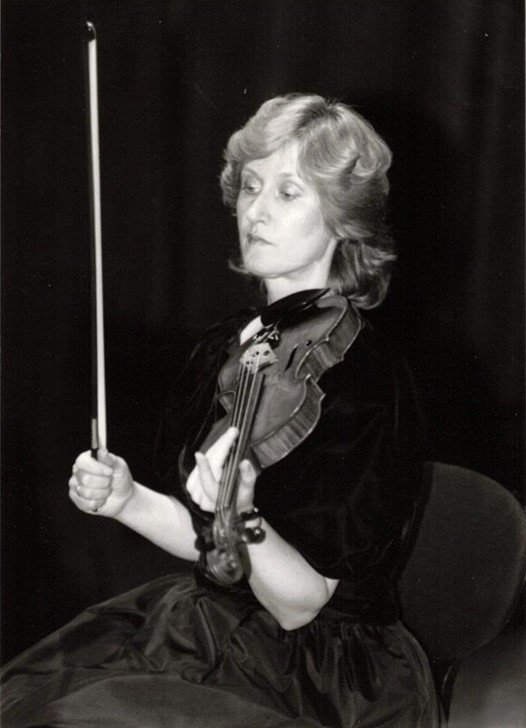
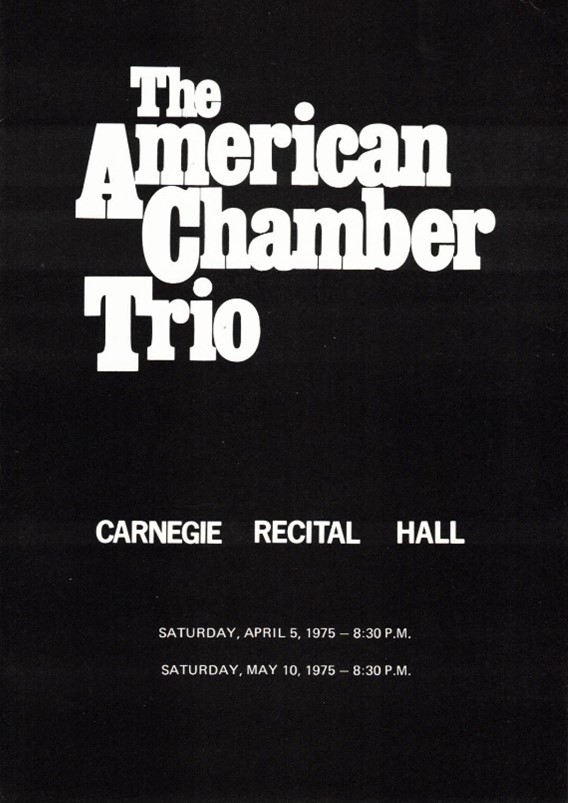
I wanted to say that I hope we played as good as we looked, but I do have a sample from 1975 and 1976 of our work:
One other thing we tried to achieve was flow in the music that we played, and the way that we went about it was to play through long sections over and over and over again to make our corrections in the flow of the music rather than to isolate sticking points. As a result, we were able to allow lines to emerge from the flow and manifest, rather than underlining them in bold type and red ink.
It was at this time (1977) that we got our first taste of touring. We got a date in Jackson, Illinois, and were able to supplement it with several dates with an organization called Mostly Music in the Chicago suburbs. We got off to a great start: On our way to rehearse with Peter the night before, we left our music in the cab. Fortunately, Peter had a set of parts for the Mendelssohn trio, and I had a clean set of Brahms C minor, which we hysterically put fingers and bowings in as soon as we got home. On our way to Jackson, our luggage went to Detroit. Fortunately, I had anticipated this possibility, so we carried our concert clothes and music stands with us. When we got to Jackson, we were able to rehearse and, for the first time, the Brahms C Minor Trio made sense, and we had a good performance, better than when we played in New York.
The second tour involved playing the Brahms Double and Beethoven Triple Concertos with the Fort Myers Symphony. In conjunction with this concert, there were four or five recitals in St. Petersburg, Naples, Tampa, etc. I don’t know how we did, but we did get invited to Florida many, many times in the ensuing years.
In 1979, we played our last important concert of the 1970s at the National Gallery of Art. It was a program of American music, and we played the Ives Trio, Amram’s Dirge and Variations, and Aaron Copland’s Vitebsk. The Vitebsk required a certain number of quarter tones, which we duly played with respect. Unfortunately, nobody told the critic from The Washington Post that it was supposed to sound like that, and we were excoriated for our excruciating intonation, so it goes. Fortunately, the American Ballet Theater was playing in Washington and offered us a free ride back to New York on their plane.
During this time, very good things were happening at both the opera and the ballet. In the late 70s, I was able to play the three big ballet solos (Swan Lake, Giselle, and Sleeping Beauty) with Baryshnikov and Makarova on national television. Also, I was able to play Pierrot Lunaire with Nureyev.
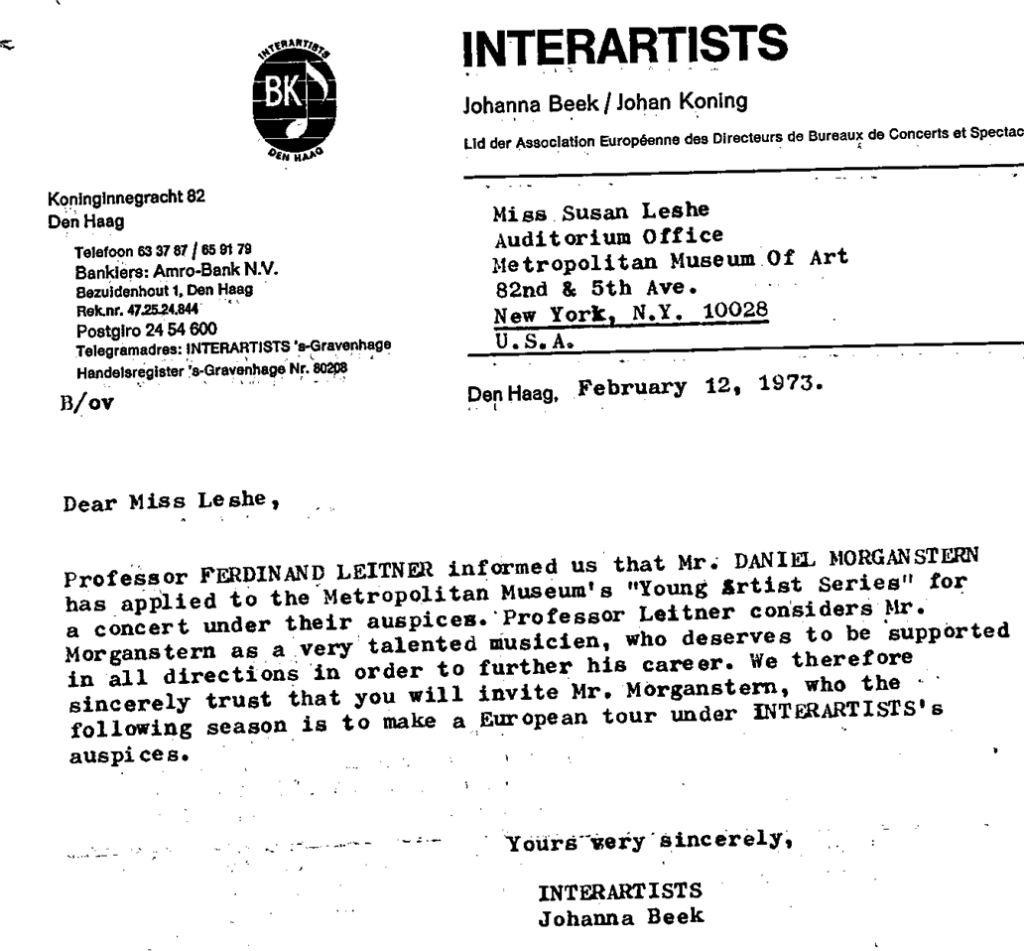
Ferdinand Leitner came to the Lyric Opera to conduct Don Giovanni we became friends almost instantly. Like my teacher Leonard Shure, Leitner had been a piano student of Artur Schnabel, and like Shure he found the only way to be a real artist was to ask the music at all times what it demands, and find a way to satisfy those demands technically. He was born in Berlin in 1912, and studied composition at the Berlin Hochschule für Musik with Franz Schreker and conducting with Brahms’ student Julius Prüwer. He became Fritz Busch’s assistant at Glyndebourne in 1935, and began his conducting career in Berlin in 1943 at the Theater am Nollendorfplatz. In 1947 he became the director of the Stuttgart Opera, and helped make that city one of Europe’s leading centers for opera. He left his position there in 1969 to become director of the Zürich Opera, and came to conduct us often.
Some conductors think of themselves as performers, but Leitner considered his primary responsibility to be a teacher. Over the years, and through persistent effort, he single-handedly turned the Lyric Opera Orchestra into a great-sounding Wagnerian ensemble. I feel fortunate to have played almost all of the Wagner operas with him, as well as several operas by Strauss and Mozart.
In spite of Leitner’s annoying habit of staring at anyone who made a mistake (we used to call these stares “bolts of Leitners”), he was one of the most loved conductors in the history of our company. We always gave him our best. While many conductors could instantaneously fix up anything that went wrong, nothing ever went wrong in a Leitner performance. He had a quiet demeanor and never seemed to have to fan the flames to get things going.
During the many intermissions I would spend with him, we would ponder whether Schubert might have evolved any further had he lived longer, since the level of greatness in his music composed in the last two years of his life made him practically the equal of Beethoven. I would play the cello solos from Strauss’ Don Quixote for him, and he would sit at the piano and play the rest of the score from memory, telling me what Strauss said about this, that, or the other thing. My favorite quote from Strauss by way of Leitner was, “Music from Mozart on is a large diminuendo, and I am the dot at the end of it.” Another thing that Leitner did for me, something unique in my forty-four-year experience with the Lyric Opera, was to get me an important European manager for a European tour I was planning. The tour never came to be, but I am still pleased to have been the third cellist on a roster with Rostropovich and Fournier.
Bruno Bartoletti was the Lyric Opera’s music director and principal conductor. He was born in Florence in 1926, and studied flute and piano at the Florence Conservatory. He made his conducting debut with a performance of Rigoletto at the Teatro Comunale in Florence, and over the years introduced many important contemporary works to the Italian stage, like Ginastera’s Don Rodrigo, Kreneck’s Jonny Spielt Auf, and Shostakovich’s The Nose. He first came to the Lyric Opera in 1956, and became the principal conductor in 1964.
His conducting technique was nonexistent, but his ability to make an orchestra sound great was undeniable. I spent more than 38 years with him at the Lyric Opera of Chicago, and this never changed. I found it fascinating that he was able to conduct amazing performances of Alban Berg’s Wozzeck and Dmitri Shostakovich’s Lady Macbeth without any kind of technique. His rehearsal method was to constantly drill the motivic material, asking for the highest degree of rhythmic precision and emotional commitment, and he would often start at an extremely slow tempo and work the material up to speed. This kind of rehearsing was possible in the late 1960s and early 1970s, because the Lyric Opera contract gave him excessive amounts of rehearsal time every week. Nothing of the sort could ever be done in the 21st century.
In his favor, he had a great sense of style and tremendous passion and energy. It was always a pleasure to play solos with Bruno because he always gave me a tremendous amount of room to make a phrase or to highlight a note. Two examples of my work with him are the solos in La Gioconda and Tosca:
00:00
00:00
Joan Sutherland came to the Lyric to sing the title role of Lucia in 1975. Her rendition of the famous “Mad Scene,” was astonishing and compelling. I simply couldn’t imagine how anybody could perform at that level, night after night. Since I had worked with Sutherland and her husband Richard Bonynge for several years I didn’t consider it inappropriate to ask Bonynge if he would arrange for me to ask his wife a few questions in private. They invited me to come to their apartment at the Executive House on Wacker Drive before a performance of Elektra.
I decided to broach the subject of performing at such a high-level night after night by complaining about my lazy cello section and how I had to do all the work. Joan Sutherland told me that when she started out at Covent Garden, she was probably a fifth-string Desdemona. Still, she was ready to walk out on the stage and deliver the role every night. She complained about how tired she was, and wondered whether she had five more years left in her (as it happened, she came back ten years later).
When I asked her how she did what she did, she told me that she first tried to sing everything perfectly in time and perfectly in tune, so that any liberty she might take was made from strength and not from weakness. She also told me that she spent most of her time relentlessly practicing the things that were really hard, and that she got a lot of help from Bonynge because of the way that he set things up. Bonynge was the only conductor I ever worked with who asked me to play as loud as I possibly could in a bel canto opera. When I mentioned that it was a first for me, he said, “What harm do you think you can do to the voices singing up there?” (and one of them was Pavarotti).
I found him to be a very fine musician, particularly in the bel canto style, and deserved all of his success. I have a lovely, autographed picture in my studio of Joan Sutherland thanking me for my most moving playing.
Copyright Daniel Morganstern. All Rights Reserved.